
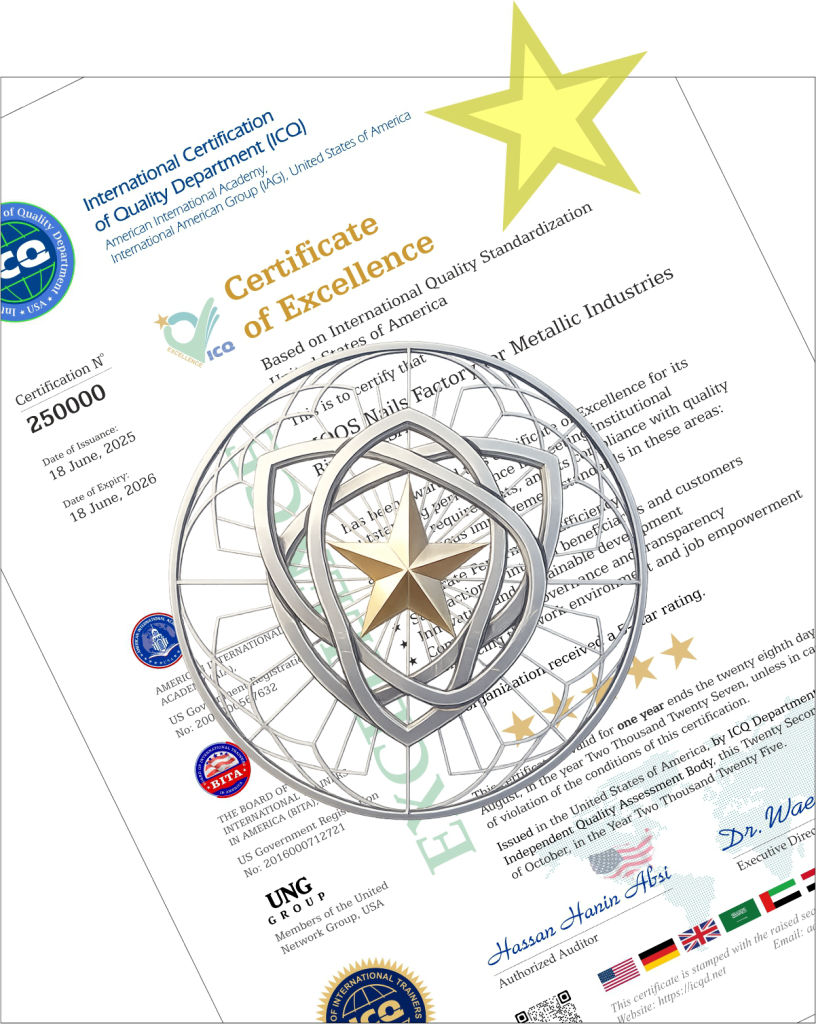
Our Institutional Excellence Certification recognizes organizations that demonstrate outstanding performance in meeting institutional excellence requirements and maintaining strong compliance with quality and continuous improvement standards across key operational areas. Certified institutions receive an official Excellence Certificate carrying a unique accreditation number, reflecting their commitment to high quality practices and sustained organizational development.
This certification evaluates performance across several core excellence domains:
A- Corporate performance efficiency.
B- Satisfaction of internal beneficiaries and customers.
C- Innovation and sustainable development.
D- Commitment to governance and transparency.
E- Enhancing the work environment and employee empowerment.
These domains represent the essential pillars of institutional excellence, ensuring that certified organizations uphold strong operational effectiveness, continuous improvement, and a culture of quality that strengthens their credibility and impact.
We offer this service at competitive rates to suit all institutions,
we offer a special discount to our members and clients.
To make the Excellence Certificate accessible during our new launch phase, we use a simple and unified pricing model. The fee is the same for all organizations and depends only on the number of excellence domains you choose. This keeps the process easy, transparent, and affordable; especially when evaluations are conducted remotely. You can select one domain or multiple domains, and the total fee will be calculated based on your selection. There are no additional charges related to organization size, type, or number of employees during this phase.
( ICQ Department may update certification criteria, fees, or policies at any time to ensure alignment with best practices. We will post any changes or updates on our website ).
Organizations pursuing the Excellence Certificate may select one or more performance domains that best reflect their strengths, priorities, and demonstrated achievements. Each domain represents a distinct dimension of institutional excellence, covering areas such as organizational performance, customer satisfaction, innovation, governance, and employee empowerment. Institutions are encouraged to choose the domain(s) where they can provide clear evidence of maturity, measurable results, and sustained improvement.
The selected domain(s) should be indicated in the Excellence Certificate Application Form, allowing the evaluation team to focus the remote assessment on the specific areas the organization wishes to highlight.
Scope Description
This domain evaluates the organization’s ability to plan, execute, and monitor its strategic and operational performance. It focuses on how effectively the institution sets clear objectives, aligns resources, and measures progress through well defined performance indicators. The assessment examines the consistency of results over time, the use of data driven decision making, and the organization’s capability to achieve sustainable outcomes that support its mission and strategic goals.
Required Documents
1- A copy of the strategic or annual operational plan.
2- A summary of key performance indicators (KPIs) and their latest results.
3- One recent performance report (quarterly or annual).
Optional (if available):
A brief example of a performance improvement initiative.
Scope Description
This domain assesses how the organization understands, engages, and responds to the needs and expectations of its customers and beneficiaries. It evaluates the mechanisms used to measure satisfaction, manage feedback, and resolve complaints. The focus is on the institution’s ability to enhance customer experience, improve service delivery, and demonstrate measurable improvements in satisfaction levels through systematic and proactive approaches.
Required Documents
1- The survey tool or method used to measure customer satisfaction.
2- A summary report of customer satisfaction results from the last 12 months.
3- A simple description of how complaints or feedback are handled.
Optional (if available):
One example of a customer‑experience improvement action.
Scope Description
This domain examines the organization’s commitment to fostering innovation and ensuring long term sustainability. It evaluates how new ideas are generated, assessed, and implemented to improve services, processes, or societal impact. The assessment also considers environmental, social, and economic sustainability practices, as well as the organization’s ability to integrate innovation into its culture and strategic direction to achieve lasting value.
Required Documents
1- A short description of one innovation or improvement initiative.
2- Evidence of implementation (a report, a screenshot, or a brief summary).
3- A simple statement on sustainability practices (environmental, social, or operational).
Optional (if available):
Any measurable results or impact of the initiative.
Scope Description
This domain evaluates the effectiveness of the organization’s governance framework, including leadership accountability, decision making structures, and compliance with policies and regulations. It also assesses the level of transparency in operations, reporting, and stakeholder communication. The focus is on ensuring integrity, ethical conduct, risk management, and clear disclosure practices that build trust and support responsible institutional performance.
Required Documents
1- A copy of the governance or organizational policy (or a summary of it).
2- A document showing roles and responsibilities (organizational chart or RACI).
3- A brief description of how risks or compliance are monitored.
Optional (if available):
One recent internal or external audit summary.
Scope Description
This domain assesses the organization’s ability to create a supportive, safe, and motivating work environment that empowers employees to perform at their best. It evaluates HR practices, professional development programs, talent management, and employee engagement mechanisms. The assessment focuses on how the institution nurtures well being, encourages participation, and builds a culture of collaboration, learning, and continuous improvement.
Required Documents
1- A summary of HR policies or employee support programs.
2- A recent employee satisfaction or engagement survey summary.
3- A list of training or development activities conducted in the last year.
Optional (if available):
One example of an employee empowerment or well‑being initiative.
If you find any part of the certification process unclear or would like guidance on how to obtain any of our excellence certifications, we invite you to reach out to our consulting office for a complimentary advisory session. Our expert consultants will provide you with all the information you need, clarify any procedural steps, and ensure a smooth and confident experience throughout your certification journey. At ICQ, we are committed to supporting you every step of the way and making the path to excellence both simple and accessible.
1. Purpose of the Certification
The Institutional Excellence Certificate is awarded to organizations that demonstrate strong performance, compliance with quality standards, and a sustained commitment to continuous improvement across key operational, educational, and governance areas. The certification aims to recognize institutional achievement, strengthen credibility, and promote a culture of excellence.
2. Eligibility
Institutions of all types may apply for the certificate, including:
- Educational institutions.
- Training providers.
- Corporate organizations.
- Non‑profit organizations.
Applicants must submit all required documents and comply with the evaluation criteria relevant to the selected excellence domains.
3. Certification Issuance Process
The certification is issued following a structured remote evaluation that includes:
- Review of institutional documents.
- Assessment of performance indicators.
- Verification of compliance with excellence standards.
- Evaluation of improvement initiatives and governance practices.
ICQ may request additional documents or clarifications during the review.
Upon approval, the institution receives:
- An official Institutional Excellence Certificate.
- A unique accreditation number.
- A validity period of one year.
4. Certification Fees
We offer this service at competitive rates to suit all institutions, and we also offer a special discount to our members and clients. Fees vary according to the 'type of institution' and the 'number of excellence domains' selected.
A. Educational Institutions.
B. Small Training Providers.
C. Small Businesses.
D. Corporate Organizations.
E. Non‑Profit Organizations.
Notes:
- Fees include document review, remote evaluation, and certificate issuance.
- Optional expedited processing is available for an additional fee.
- Partner institutions may receive discounted rates.
- Final fees are confirmed after reviewing the application.
5. Certificate Validity
The Institutional Excellence Certificate is valid for one year from the date of issuance.
6. Renewal Policy
6.1 Renewal Requirements:
To maintain active accreditation, institutions must renew their certificate annually by submitting:
- Updated KPI Summary for the past year.
- Evidence of improvements and development initiatives.
- Updated customer/beneficiary satisfaction indicators.
- Updated employee development and training records.
- Notification of major organizational or policy changes.
- Confirmation of continued compliance with excellence standards.
6.2 Renewal Review Process:
- Renewal is conducted through remote document review.
- Only updated or newly relevant documents are required.
- ICQ may request clarifications or additional evidence.
- Upon approval, the certificate is renewed for one year.
6.3 Renewal Fees:
Renewal fees are set at 50-70% of the initial certification fee, depending on:
- Institution type.
- Number of domains included in the certificate.
Final renewal fees are communicated after reviewing the renewal application.
7. Lapsed Certificates (Two Years or More)
If an institution fails to renew its certificate for two consecutive years or longer, the certificate is considered fully expired.
In such cases:
- The institution must reapply as a new applicant.
- All initial documentation must be resubmitted.
- Full initial certification fees apply.
- A complete evaluation is required.
8. Certificate Cancellation Policy
ICQ Department reserves the right to suspend or cancel a certificate under the following conditions:
8.1 Grounds for Cancellation:
- Submission of false, misleading, or manipulated information.
- Failure to comply with excellence standards.
- Significant decline in institutional performance.
- Refusal to provide required documents or updates.
- Major violations of governance, ethics, or quality practices.
- Misuse of the certificate or accreditation number.
- Actions that damage the credibility of ICQ or the certification system.
8.2 Cancellation Procedure:
- ICQ notifies the institution in writing of the issue.
- The institution may be given an opportunity to provide clarification or corrective action.
- If non‑compliance is confirmed, the certificate is cancelled.
- The institution must immediately stop using the certificate and accreditation number.
8.3 Reinstatement:
Cancelled certificates cannot be reinstated.
The institution must apply again as a new applicant.
9. ICQ Rights and Updates
ICQ Department may update certification criteria, fees, or policies at any time to ensure alignment with best practices. We will post any changes or updates on our website.
A KPI (Key Performance Indicators) summary is a brief document that highlights the institution’s most important measurable results. It shows whether the institution is meeting its goals in areas such as performance, quality, customer satisfaction, and efficiency.
Typical elements in a KPI summary:
1- Key performance metrics (e.g., completion rates, satisfaction scores, growth percentages).
2- Targets vs. actual results.
3- Trends (improving, stable, declining).
4- Short notes explaining major achievements or gaps.
Why we request it for the Excellence Certificate?
Because it gives a quick, reliable picture of how the institution is performing without needing a full evaluation visit.